Women in the War

Good Night, Irene

By Luis Alberto Urrea

I’ve read countless books about WWII. In fact, my bookclub once spent an entire year reading nothing but books about the marginalized stories of WWII victims and survivors. Needless to say I thought I had read it all, but this book surprised me. I had never heard of the Donut Dollies of the Red Cross or about the Clubmobiles (GMC 2 1/2 ton trucks made into kitchens on wheels) they drove through Europe and into the thick of battles to bring a smiling face, a cup of coffee and a donut to the fighting soldiers.

Urrea is a master storyteller capturing the chaos of war raging and the chaos of a world not changing fast enough. The task set forth for these brave determined women is at once just as dangerous as soldiering, maybe more so due to their lack of training, but their service is not valued as an equal contribution by society.

“You weren’t even a soldier. You were making cookies. What could you possibly have to get over?”

Urrea highlights the mental anguish these women went through to serve their countries and to create space for themselves in a world defined by the actions of men all the while buoyed by friendship and determination to survive. There aren’t a lot of stories about women seeking adventures. In the past this seems to have been a genre written predominately about men and their struggles, but Urrea captures the complex nuances of female relationships quite well and what would drive these women to break through barriers and defy family expectations.


I believe this is Urrea’s finest work to date.
A Progressive Omission

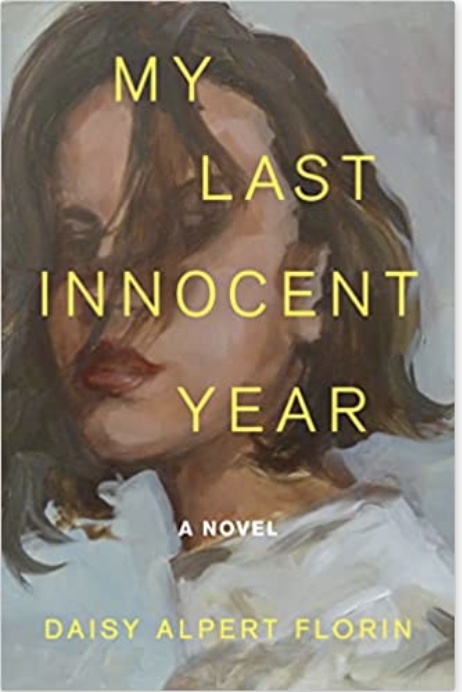
My Last Innocent Year: A Novel by Daisy Alpert Florin

Reviewed by Rebecca J Duncan

My Last Innocent Year: A Novel by Daisy Alpert Florin is a coming of age story set at the end of the last century, which is a scary way of saying the late 1990’s. For those of us lucky enough to live through the toxic amounts of hairspray and kohl black eyeliner applied with a jumbo crayon, Florin’s seemingly effortless prose will make you nostalgic for your oversized flannel shirt and that glorious time when you knew everything and nothing all at the same moment. But there is more to be found in Florin’s pages than memories of youth. She is saying something very important by not saying anything at all.

Isabel is your average college senior, excited for her last year of school and worried about what she will do after graduation. We learn a lot about her history and her friends, but what is different than many other books in this genre is that while Isabel may not know her own mind she is very comfortable with her sexuality as a woman. This seems small, but it is a relatively new development in literature.

Isabel is 21-years-old. She is sexually active and has been with several partners. She will experience a possible date rape, a relationship with an older professor and flirtations along the way and yet that isn’t the focus of the story. The focus is on Isabel learning her own mind and following her dreams. The days are long past( I hope)when heavy handed morality tales bent on scaring young girls onto the path of purity and obedience were published with ease, but their successors have been around in disguise every time a teenage girl gets pregnant after a night with the town bad boy. Every time the heroine is run out of town for sleeping with a married man. In each of these tropes, judgement is passed and it falls on the woman. Sex is dangerous for you and you are bad for wanting. You will be punished!

Florin sidesteps these cliched traps and instead traverses the higher ground of Isabel’s psyche. Who is she as an adult? As a woman? What are her thoughts and beliefs? You will always be your parent’s child, but what do you owe them or their memory? These questions are at the center of this novel.

By choosing or refusing to make Isabel’s sexuality the center of the story Florin has normalized Isabel’s right to sexual freedom. Free from judgment and free to find her path anyway she chooses.

Women Talking by Miriam Toews

Miriam Toews’ latest offering Women Talking is based on a true story of a Mennonite colony in Bolivia and the unspeakable violations the women of that community suffered at the hands of their own.

But rather than be about the details of the crimes, Toews chooses to focus on the women, their reactions, and the choices that they now have to make as they find out their attackers or “unwelcome visitors” as the elders prefer to call the rapists who are being bailed out of jail by the men of the colony and will soon be returning.

The women decide that they have three choices:

Do Nothing

Stay and Fight

Leave

The women gather in a hayloft to discuss their options and through these discussions the reader gets a glimpse of the pain, powerlessness and anger the women feel as they are caught between deciding what is more important– their own safety and that of their children or their religion as it is explained to them by men. Since women haven’t been taught to read, they have never read the Bible or been allowed to interpret the scriptures on their own, but they are starting to suspect that what they have been told may not jive with the true teachings of the Lord.

“She had everything she wanted; all she had to do now was convince herself that she wanted very little”

The antiquated lifestyle and speech of the Menonites makes this novel feel like it is from the distant past when in fact these crimes took place between 2005-2009 and the subject matter couldn’t be more timely. The women discuss their lives under a patriarchal rule and the reader can’t help but realize that while Toews is discussing an isolated colony in Bolivia she could easily be talking about women anywhere and that the three choices the women have in the novel are the same three choices that face millions of women everyday.

Toews does a wonderful job of demonstrating how infantilizing a patriarchy is to women. By overloading them with daily chores, refusing them a basic education and allowing the women no voice in lawmaking or decisions the women are little better than slaves. But does one realize that they are slaves or being abused if they have never known anything else? Not all the women are aware of their inferior status within the colony and this revelation of acceptance, of willing to live by the status quo sometimes makes reading this novel hard. I often felt like grabbing and screaming at these women to stop discussing and start packing. But I also realized that I was reading this book from a position completely different from these women, a position of the educated, a position of the independent, a position of power, in other words a position of more than three choices.

When we have liberated ourselves, we will have to ask ourselves who we are.

A Thousand Ships by Natalie Haynes

Sing Muse Sing

O sing muse…sing dammit. Why is my muse so fickle–probably because I demand much and give so little in return. Admittingly, I also love to verbally abuse my imaginary muse (and Siri or Alexa depending on how helpful they are) and apparently so does the poet in Natalie Haynes latest offering A Thousand Ships, a retelling of the Trojan war from the women’s viewpoint. The muse abusing poet is not alone in his treatment of women for who doesn’t abuse women in the Greek classics? Homer’s Iliad and Odyssey both contain lots of raping and lots of slavery but bizarrely nary a complaint written down from the women. Let’s also not forget about Euripides’ Electra or Antigone and their treatment either. I guess we do find a lot of weeping, rending of garments, and tearing of hair, but all of that is explained away as custom and duty as if women existed as some sort of grotesque theater troupe caught in the middle of a performance piece rather than as human beings who deserve to have their roles acknowledged and not have to wait for an offended god to take revenge on their behalf.

O muse can you offer inspiration to save us from patriarchal literature–like now. If it’s not too much trouble. Please.

In A Thousand Ships Haynes acknowledges these roles and sets free the voices of the women whose lives were thrown into chaos by the rashness of men. She tells the stories of famous Greek women like Clytemnestra and her daughter Iphigenia and their anger and despair at Aulis when they realize that they have been set up and lied to my Agamemnon. She tells the story of the Trojan women who sit on the beach after the fall of Troy waiting to see which of the Greeks will now own them. She even gives voice to patient Penelope in the form of letters to her overdue husband Odysseus that cannot help but expose that she was anything but patient and understanding as Homer would like us to believe, but instead very much aware of her husbands adventures and angered at how his choices left her in a virtual prison for 20 years of her life–and a single mom to boot. Haynes gives the reader the other side of the story. The fear, the anger, the betrayal of knowing that no matter your station in life you had no control over your future. Slaves and queens both were lost to history and left voiceless–until now.

A Thousand Ships is one of several novels lately that has attempted to right the wrongs of one sided Greek literature. Pat Barker’s Silence of the Girls and Circe by Madeline Miller each deal with recognizable women from Greek literature who have finally been heard. These retelling of long established patriarchal tales are much needed and I hope the trend continues and spreads into other genres besides just Greek literature. Dare I say Shakespeare? Just remember to ask the muse nicely.